
Looking for a best selling book to help us move forward together with warmth and wonder in our times?
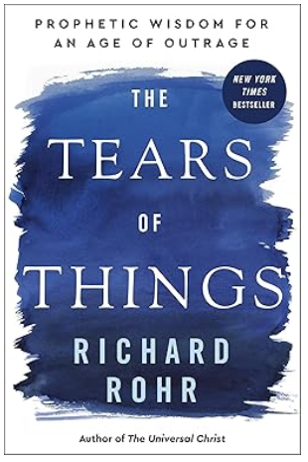
The Tears of Things steps into our soul like a quiet companion for a noisy age. Richard Rohr does not shout solutions or prescribe moral certainty. Instead, he invites us into a deeper way of seeing, one that feels surprisingly practical for any curious reader seeking wisdom, resilience, and growth ( without preaching) and filled with grace in our uncertain times.
At its heart, this book explores how wisdom emerges not from avoiding pain or complexity, but from learning how to hold them without shrinking. Rohr draws on ancient insight while speaking directly to modern lives shaped by anxiety, polarization, and exhaustion. What makes Rohr’s work accessible is that it does not ask us to believe more, but to notice more. The invitation is toward awareness, integration, and compassion as doable skills we can practice daily.
From a neuroscience perspective, Rohr’s wisdom aligns closely with what we now understand about the brain, grace and growth. When we stay trapped in fear, blame, or rigid certainty, our nervous systems narrow. The amygdala dominates, pushing us into fight, flight, or freeze. Rohr repeatedly encourages a posture of patience, curiosity, and humility, which mirrors how the prefrontal cortex comes back online when we slow down and observe rather than react. In this way, wisdom becomes a biological as well as a philosophical process.
One of Rohr’s central insights is that suffering, when met honestly, can soften rather than harden us. Neuroscience supports this reality. For instance, experiences that are integrated rather than suppressed build neural flexibility. We grow not by bypassing pain, but by allowing meaning to form around it. Rohr’s language gives dignity to this process, helping us see that tears are not signs of failure, but evidence that our humanity is intact.
For thinkers, this inspirational book offers a compelling reframing of intelligence. Instead of rewarding quick answers or dominance, Rohr elevates what might be called integrative intelligence. This is the capacity to hold paradox, tolerate ambiguity, and resist simplistic narratives. Research on cognitive complexity shows that such minds are better equipped to solve systemic problems. In a world shaped by chaotic leadership and short-term greed, this kind of thinking is not passive. Such wisdom is quietly a radical transformation.
For the discouraged among us, Rohr’s writing acts as reassurance without sentimentality. He does not deny the harm caused by desperation-driven systems or self-serving leaders. Yet he reminds us that transformation rarely begins at the level of power. It begins in our mindset or perception. Neuroscience tells us that meaning-making is one of the strongest buffers against despair. Rohr nurtures this capacity by helping us recognize that even fractured moments can become sources of wisdom when we remain present to them.

What makes The Tears of Things especially relevant now is its insistence that personal growth and collective healing are inseparable. When we learn to regulate our own fear, we reduce the contagion of fear around us. When we choose compassion over contempt, we interrupt cycles of reactivity that dominate public life. Rohr does not frame this as moral superiority, but as maturity, the kind that allows us to help others live more fully simply by being less defended ourselves.
Ultimately, this book offers a growth mindset rooted not in relentless positivity, but in courageous realism and possibility through grace. It trusts that wisdom grows where honesty and compassion meet. By blending ancient insight with a deeply human understanding of how we change, The Tears of Things gives us language and posture for living well amid uncertainty.
In our time marked by chaos, greed, and desperation, Rohr’s contribution is not an escape, but a grounding. He reminds us that when we learn to see clearly and feel deeply, we become quieter agents of sustainable repair. And from that healthier and healing place, our lives begin to widen, making room for others around us to do the same.